
How the Franklin County Court Calendar Works
Several official channels answer different questions in Franklin County. The case notice or order speaks to your case alone. The North Carolina eCourts Portal locates public cases. Its Search Hearings tool locates scheduled data. An official calendar organizes whole sessions. When sources conflict, work through them in that order. Let the Franklin Clerk of Superior Court settle anything left over, especially after a closure-related change.
Franklin County runs a Superior Court and a District Court. Each calendar entry ties to a specific case, division, setting type, and notice. Criminal, civil, traffic, family, and clerk-administered matters share one county court system. They do not share one calendar workflow. To know what a listed event means, trust the current case record. Do not rely on the general label a schedule carries.
Portal and the clerk also do different jobs. Portal gives public case information, while the clerk keeps the official court file. A calendar result can prompt you to verify details. It is neither a certified record nor a filing route.
Franklin County Court Date Sources
Start statewide with the North Carolina Court Dates page, which points the way on court-date lookups. For Franklin County, pair that page with Portal Search Hearings. Add the case notice, local administrative schedules, and the clerk. A court date search can come back empty for several reasons. The date range, location, or filters may be off. No public hearing may be scheduled, or the record may be restricted. An empty result is never proof that no court event exists.
| Franklin County source | What it answers | What still controls |
|---|---|---|
| Notice or order | The direction delivered for a particular case | The court's current direction in the case |
| Portal Search Hearings | Public scheduled-hearing data when available | Compare location and date with the notice |
| Calendar interface or local schedules | Session organization and current links | Do not infer an individual courtroom assignment |
| Franklin Clerk of Superior Court | File and closure-related confirmation | Access and records remain subject to law |
The Court Dates source is shown in this official reference.
A public search result works best when checked against the notice and the clerk. Franklin County court-date work is strongest that way, not when a result stands alone.
Franklin County Court Date Lookups
A case number is the strongest route to a Franklin County court date. Portal's Search Hearings accepts a case number. It also takes a party name, business name, attorney name, attorney bar number, judicial officer, or courtroom. Then add a location, a hearing type, and a date range. Pick Franklin County when that option appears. Keep the range practical. The broad statewide courtroom selector can help with discovery. Yet it can also grab the wrong place.
When a docket search finds the case but not the date, do not assume the setting vanished. Check the case notice. Rerun the hearing search with new criteria, and open the current local calendar links. Call the clerk if the question remains. A public record may be restricted, or the event may simply fall outside the range you set.
- Read the case notice or order for the date, court, and any instructions.
- Use the case number in Portal Search Hearings, choosing Franklin County where possible.
- Check the displayed hearing type, location, and date range against the notice.
- Review the current local schedule or calendar route for session context.
- Call or visit the Franklin Clerk of Superior Court if a closure, record-access limit, or file question needs confirmation.
Franklin County Court Schedule Hearing Fields
Portal's hearing interface finds scheduled information; it does not decide what a court will do. Read each field with care. A date and time mark a listed event. Compare the location and courtroom fields against the notice. A judicial officer or hearing type can help separate similar entries. No field predicts an outcome or replaces a last-minute instruction.
| Case number | The most direct identifier for a public hearing search when known. |
|---|---|
| Location | Choose Franklin County when the interface offers a location filter. |
| Date range | Limits the search to the period selected; a wrong range can produce no result. |
| Hearing type | Describes the setting category supplied by the source, not the final disposition. |
| Courtroom or judicial officer | Useful public search fields that must be checked against the case notice. |
The Franklin County local administrative schedules page is the official local entry point. It gathers current calendar and schedule links in one place.
Local Franklin County schedule links supplement a hearing search nicely. For a specific appearance, the case notice is still the source to follow.
Court Settings: What Each Field Means
A Franklin County court setting is a scheduled court event. It is not always a trial date. It does not promise the case ends that day. Dockets and schedules record hearings, calendar calls, motions, arraignments, pretrial conferences, and more. Read any setting alongside the case number, the date, the location, and the notice. One calendar session may hold many cases without defining each case's next action.
Keep three terms straight. A docket or Register of Actions records public case events. A hearing is a scheduled matter in one case. A calendar lists and organizes court sessions and settings. Franklin County records connect all three, but the documents are not interchangeable.
- Setting
- A scheduled court event associated with a case, subject to change by the court.
- Continuance
- A court-approved move of a scheduled matter, not merely an edit a party makes to a calendar.
- Calendar call
- A court-management event that can organize matters before a session.
- Register of Actions
- A public summary of docket entries based on the clerk's record, rather than the official record itself.
Franklin County Court Notice and Calendar
When a Franklin County notice and a general calendar seem to disagree, start with the notice or order. Get confirmation from there. The calendar organizes a session; the notice directs a party in a particular case. A Portal hearing result supplies public scheduling data. These functions can align, yet none substitutes for another. The clerk can explain the available file. The clerk can also give the official route for a changed or unclear setting.
Quick answer: A Franklin County calendar entry is not a promise that the listed time, room, or event will stay unchanged. Confirm an individual court setting through the current notice, hearing search, and clerk when needed.
The official North Carolina court calendar interface is its own calendar route. It stands apart from Portal's public case and hearing searches.
Confirming a Franklin County court date takes the actual case details. A broad calendar label alone will not tell you when your matter is set.
When a Court Date Moves
Court dates in Franklin County move for several reasons. A continuance can shift a setting. A reset, a weather closure, or a scheduling decision by the court can too. A continuance is a ruling by the court. No party can make that change by editing a calendar. The local civil planning document describes a written continuance request on AOC-CV-221. It notes that the decision-maker can change depending on when a session begins. Treat that material as dated local context. It neither approves a request nor sets a current court date.
For civil calendar procedure, the posted plan says trial calendars are published at least 30 days before a session. Updates come about five to ten days before. Those are planning details only. A current notice, an official schedule, and direction from the court always supersede them. Criminal local-plan material works the same way. It is useful for historical workflow, not for guaranteeing a present setting.
Note: A Franklin County court setting changes only through the court's current process. Do not rely on an old calendar alone.
Franklin County Civil Court Schedule Updates
For documents that affect how Franklin County courts operate, the Franklin County local rules and forms page is the official route. The civil plan walks through administrative weeks, motion calendars, trial calendars, and the written continuance procedure. Those details explain why a case, a motion setting, a session calendar, and an updated schedule show up as related but separate items. Still, none of it points to a live courtroom or a current judicial instruction. Use the plan as context. Use current case information for the actual date and place.
Read the local rules for context, nothing more. The current case record settles any date, place, or appearance requirement.
Missed Settings and What Comes Next
A missed Franklin County court setting is not a calendar problem. You cannot solve it by guessing a new date. The court may act after a missed appearance. What happens next depends on the case and the court's direction. Call the Franklin Clerk of Superior Court right away. Have your case number or citation information ready. The clerk handles procedural routing and public file details. Any order or next setting belongs to the court.
Act promptly. For a missed Franklin County court setting, use the current notice, case number, and clerk contact route. Do not rely on an old calendar, an unverified message, or a third-party listing as a replacement for a court order.
The Franklin County contact directory provides official clerk and court-service routing.
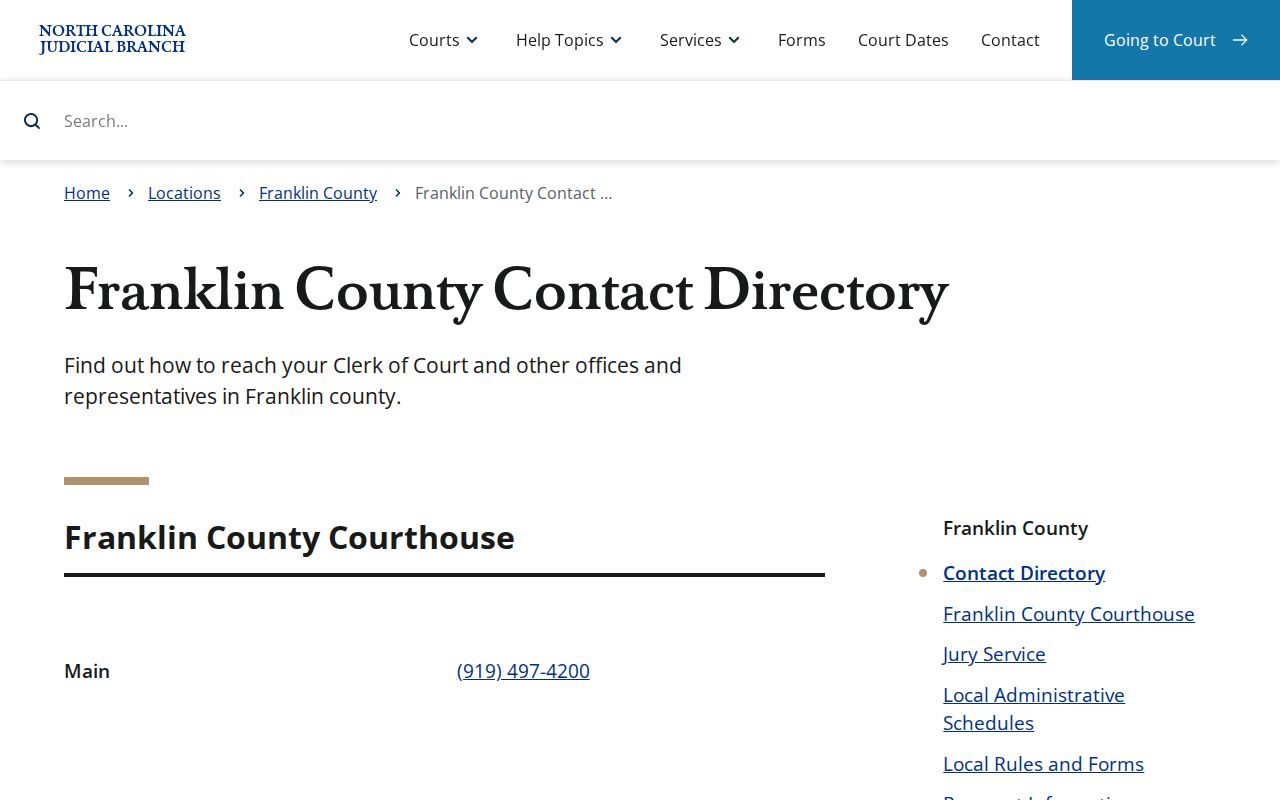
Franklin County contact details exist to route a setting question into the court system. A calendar search should never become an unofficial decision.
Franklin County Court Date Closure Check
Weather or emergencies can change a Franklin County court schedule. State guidance says rescheduling information may be mailed. The clerk can help confirm the result. Before you travel, read the current case notice. Check the county court location or schedule source, and call the clerk if an official closure or access question affects your appearance. Never rely on a speculative replacement date.
Franklin County's courts use both the historic courthouse and the Hobgood Annex. A case type will not tell you which room holds your hearing. The Franklin County court location page is the live official source. It covers court locations and county services. Your notice and current court instructions decide where to report.